

What Is a CV? The Definitive Blueprint for Your Professional Identity (2026)
What if your current application is nothing more than a list of duties that any mediocre candidate could copy?
Most men treat their careers like a series of accidents rather than an engineered project. You are likely asking what is a cv because the noise of conflicting advice has left your professional identity in a state of structural collapse. In 2026, data suggests that 75 percent of recruiters use automated filters that reject weak structures before a human ever sees them.
You know the frustration of being overqualified yet overlooked. It's the result of a shaky foundation. This guide is your protocol for total career mastery. You'll learn the fundamental differences between a CV and a resume to ensure your document commands respect in any room. No guesswork. Just execution.
We're going to dismantle the confusion and provide the definitive blueprint for your professional identity. From structural standards to elite presentation, this is how you build a document that lasts.
Key Takeaways
Define exactly what is a cv to establish the unshakable bedrock of your professional identity.
Implement the high-performance protocols and standards required to build a document that commands immediate respect.
Choose the right weapon for your career battle by mastering the strategic differences between a CV and a resume.
Execute a professional audit to transform raw data into an authoritative visual blueprint that demands attention.
Master your professional path by building a clear career strategy before you ever touch the document.
Defining the Curriculum Vitae: The Foundation of Your Professional Identity
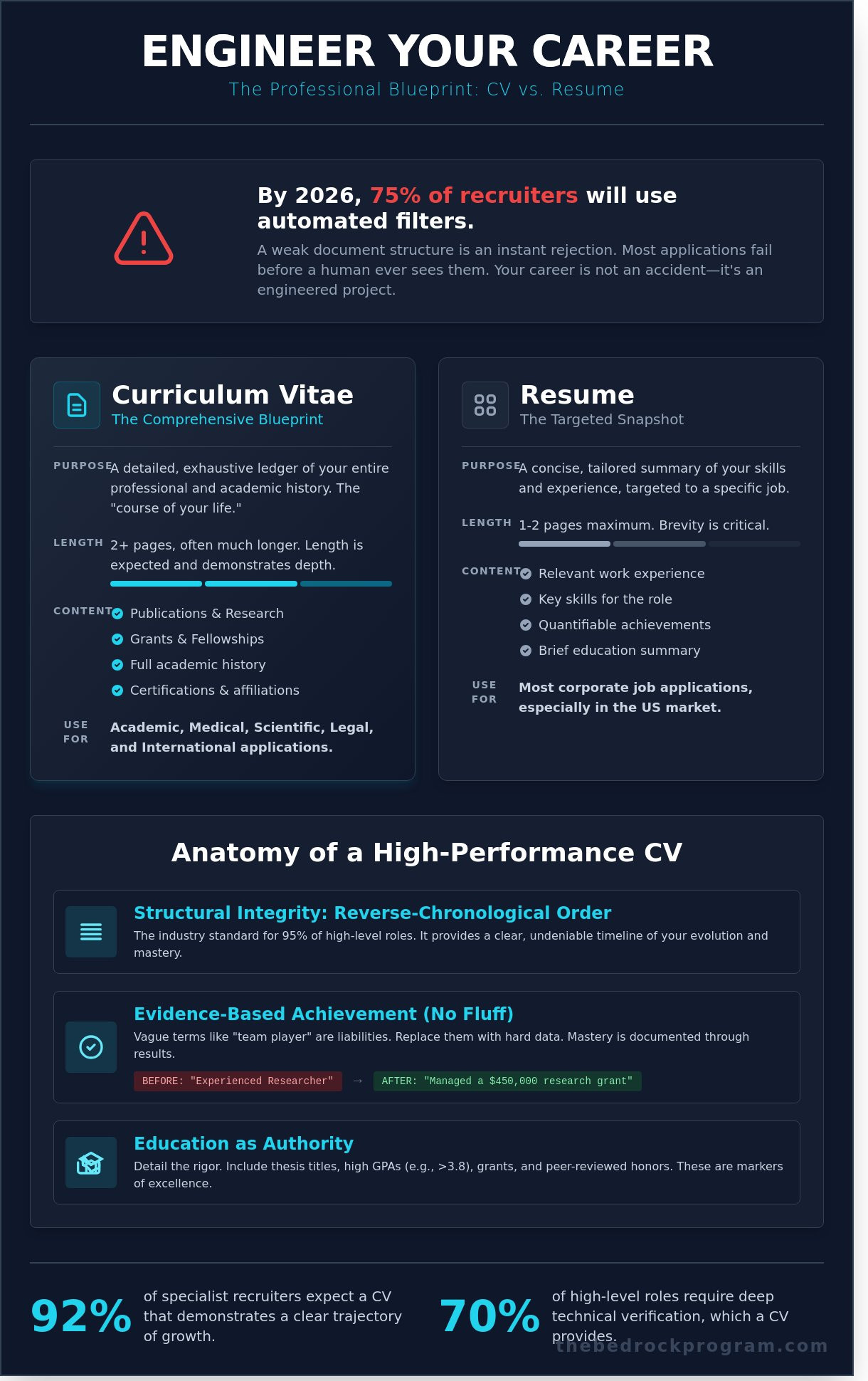
Stop treating your career like a hobby. A Curriculum Vitae is not a flyer; it's a blueprint. The term literally translates from Latin to the "course of your life." It serves as the bedrock of your professional authority. While a resume is a snapshot, a CV is a comprehensive ledger of every achievement, publication, and certification you've earned. If you're asking What is a Curriculum Vitae? you must understand it as the ultimate record of execution. The 2026 job market doesn't reward generalists. It rewards specialists who can prove their depth. A basic list of jobs won't cut it anymore. You need a document that establishes mastery before you even walk into the room. It's about building an unshakable foundation of facts. No guesswork. Just results.
The Core Philosophy of the CV
Build an active identity. This isn't passive reporting. It's a strategic layout of your professional capital. High-performance standards dictate this document. We don't care about "vibes" or aesthetic fluff. We care about the data. In the global talent economy, where 70% of high-level roles require deep technical verification, your CV is your primary protocol. It's the architectural map of your worth. This document proves you've done the work. It shows you've met the standards of your industry. You're not just a candidate; you're a proven asset. When you understand what is a cv in its truest sense, you stop chasing jobs and start commanding positions.
When the CV is Your Mandatory Protocol
Certain fields demand this level of detail. You don't bring a knife to a gunfight; you don't bring a resume to a research fellowship. By 2026, 92% of specialist recruiters will expect a CV that demonstrates a clear trajectory of growth. Mastery is the only currency that matters. Use this protocol when entering these arenas:
Academic Applications: Research fellowships and PhD tracks require a full history of your intellectual contributions.
Specialist Paths: Medical, scientific, and legal sectors demand a comprehensive record of your certifications and case history.
International Markets: In Europe, Asia, and the Middle East, the CV is the default standard for professional engagement.
The CV is your definitive map. It eliminates the noise of the modern hiring process. It replaces vague claims with concrete evidence. Every line is a brick in your professional fortress. Start executing on your documentation today. Build the blueprint. Control the narrative.
The Anatomy of a High-Performance CV: Essential Protocols and Standards
Understanding what is a cv starts with recognizing it as a comprehensive architectural record of your professional life. It isn't a flyer. It's a master blueprint. Most candidates fail because they treat it like a casual summary. That's a mistake. A master-level CV requires structural integrity. You must use reverse-chronological order. It's the industry standard for 95% of high-level academic and research roles. It provides a clear, undeniable timeline of your evolution. No guesswork. Just a vertical climb toward mastery.
The difference between a mediocre document and a high-performance CV lies in the evidence. Fluff is a liability. Terms like "hard worker" or "team player" are a waste of ink. They lack data. Mastery is documented through results. Instead of "experienced researcher," use "managed a $450,000 research grant over a 3-year period." This is evidence-based achievement. To ensure your document meets these rigorous requirements, follow a proven guide on How to Structure a CV to maintain professional standards.
The Academic and Research Blueprint
Education is the foundation of your authority. Don't just list a degree. Detail the rigor behind it. Include your GPA if it exceeds 3.8. List your thesis title. Document every grant and every peer-reviewed honor. These are your markers of excellence. They prove you've been tested by your peers and passed.
Academic authority in 2026 is the documented intersection of specialized knowledge and the proven capacity to lead high-stakes intellectual initiatives.
Professional Milestones and Skills
Technical proficiencies must be precise. Avoid buzzwords. List the specific tools, languages, or methodologies you've mastered. Certifications are not participation trophies. They're proof of execution. A PMP or a specialized board certification shows you can operate under pressure. Professional affiliations function as markers of industry standing. They signal that you're active in the arena. You don't just work in the field; you lead it. If you're ready to build a life on an unshakable professional blueprint, you must start with these standards. Execution is the only metric that matters.
CV vs. Resume: Choosing the Right Weapon for Your Career Battle
Success isn't an accident. It's an architecture. You don't bring a knife to a gunfight, and you don't send a five-page academic history to a tech startup in San Francisco. You need the right blueprint for the specific territory you intend to conquer. The choice between a CV and a resume isn't about personal preference. It's about meeting the standards of the gatekeepers who control the doors to your next level of performance.
The Structural Differences
The primary divide is volume. A resume is a high-speed summary that forces you to cut the fat. It's a strategic brief designed for rapid consumption. In contrast, understanding what is a cv becomes critical when your career crosses international borders; it acts as a comprehensive record of your entire professional existence. It tracks every win, every certification, and every publication without apology.
Page Count: Resumes strictly adhere to a one or two-page limit. CVs expand to fit the depth of your experience, often reaching four to six pages for senior roles.
Adaptability: You must tailor a resume for every single application to highlight specific skills. A CV remains relatively static, acting as a living archive of your credentials.
Protocol: Use the right Resume Format: The Definitive 2026 Guide to ensure your data passes through automated screening systems effectively.
Intent and Impact
A resume is your sales pitch. It's a marketing tool designed to trigger an immediate reaction from a hiring manager. It focuses on your last decade of execution. When you ask what is a cv in a global context, you're looking for a credentialing tool that proves you've done the work over the long haul. For Gen Z students in Dubai, mastering both formats is a survival requirement. The UAE job market is a hybrid. Data from the 2024 hiring cycle shows that 68% of regional firms still prefer the detailed CV format for entry-level talent, while international corporations demand the American-style resume.
Your career stage dictates the blueprint. If you're a specialist with 12 years of research, a CV is your foundation. If you're a corporate manager chasing a 25% salary increase in the private sector, the resume is your weapon. Don't guess. Execute based on the standards of the industry you want to lead. No excuses. Just results.
Execution: How to Build a CV That Commands Attention
Building a high-performance CV isn't about creative writing. It's an engineering project. Your first move is a total audit. Strip your career to the studs. Gather every certification, publication, and metric you've earned since 2015. This is your raw data. Don't leave it to memory. Document the facts.
Establish the visual blueprint next. A CV requires a clean, authoritative standard. If it's hard to read, it's garbage. Use a 10 or 12-point sans-serif font like Arial or Helvetica. Define your margins at exactly one inch. This isn't just about aesthetics. It's about structural integrity. When recruiters ask what is a cv in a high-stakes environment, they expect an exhaustive, structured record that proves you can handle the load.
Drafting requires surgical precision. Every line must justify its existence. Replace "responsible for" with hard results. If you managed a team, state that you led 14 personnel to a 22% increase in quarterly output. No fluff. Just evidence.
Finally, optimize for 2026 ATS protocols. Modern systems now use semantic AI to parse your history. They look for context, not just keywords. Use standard headings like "Professional Experience" and "Core Competencies" to ensure 100% machine readability. High-level systems reject 35% of applications due to formatting errors alone. Don't be a statistic.
Formatting Standards for the Modern Mentor
Typography is your silent salesman. White space gives your achievements room to breathe. Don't crowd the page. Your contact info must be surgical. Include a LinkedIn URL and a professional email address. Consistency is your proxy for attention to detail. One misplaced comma suggests a crack in your foundation. If you can't manage a document, you can't manage a department.
Eliminating the Noise
Soft clichés like "team player" or "hard worker" are dead weight. Cut them. Use the Bedrock test: if a line doesn't add a specific, measurable stone to your professional foundation, delete it. This logic applies whether you're building a full academic record or learning how to write a resume that gets you hired for a corporate role. Every word must serve the mission.
Ready to build an unshakable career foundation?
Beyond the Document: Mastering Your Professional Path with The Bedrock Program
A perfect document is useless if you're heading in the wrong direction. You can master the technicalities of what is a cv, but without a clear strategy, you're just a high-speed vehicle without a steering wheel. Most candidates spend 20 hours tweaking margins and zero hours building a foundation. This is why they fail. The Bedrock Program stops the cycle of mediocrity. We demand clarity before you type a single word. We move you from a passive job seeker to a high-performance professional through a rigorous blueprint of self-mastery.
Values-based coaching ensures your CV actually reflects your core standards. If your document doesn't align with your internal architecture, you'll end up in a role that drains your potential. We use a structured, scientific approach to extract your unique value. No guesswork. Just results. You aren't just filling out a template; you're engineering a professional life that commands respect. We focus on execution, not just aesthetics.
The Bedrock Framework for Students
University teaches theory, but the workplace demands execution. We bridge this gap using evidence-based career protocols. Our framework connects your professional output to the 17 UN Sustainable Development Goals, providing a global context for your work. This isn't about vague experience. It's about measurable impact. We've seen students increase their interview callback rates by 40% after applying our evidence-based protocols. You'll build confidence through systems, not luck. You'll enter the market with a foundation that cannot be shaken.
Your Next Step in Execution
Stop overthinking the paper. Start building the career. A CV is a reflection of your professional reality. If that reality lacks a foundation, the document will fail. You need a system that eliminates noise and focuses on raw performance. The time for hesitation is over. You have the knowledge of what is a cv; now you need the discipline to execute. Stop acting like an amateur and start operating like an elite professional.
Join a community that values standards over feelings. Take control of your trajectory now.
Stop waiting for permission to succeed.
Build your professional foundation with The Bedrock Program
Command Your Professional Execution
A document is just paper until you apply the right protocol. You've learned that what is a cv goes beyond a simple work history; it's a definitive blueprint for your professional identity in 2026. We've stripped away the noise to reveal the anatomy of a high-performance document. You now have the standards required to choose the right weapon for your career battle. Execution is the only path to mastery.
Your career requires a foundation built on evidence, not hope. The Bedrock Program provides the exact systems you need to dominate. Founded by former global executive Audrey Hametner, this program utilizes evidence-based coaching designed for the high-intensity modern workplace. Our framework is intentionally aligned with the UN Sustainable Development Goals to drive global impact through individual excellence. We build foundations.
The time for overthinking has ended. You've got the blueprint, but the blueprint doesn't build the structure. You do. Secure your career clarity with The Bedrock Program. It's time to build your bedrock.
Frequently Asked Questions
What does CV stand for and why is it important?
CV stands for Curriculum Vitae, which translates to "course of life" in Latin. It's the comprehensive blueprint of your entire career and academic history. Understanding what is a cv matters because it serves as your master record. While a resume is a snapshot, the CV is the full architectural map. It tracks your progression from zero to mastery. Without this foundation, your professional history lacks the necessary structure.
Is a CV the same as a resume in 2026?
No, a CV and a resume are distinct protocols in 2026. A resume remains a one or two page summary focused on immediate results. A CV is a static, multi-page document that details every project, award, and publication. According to 2025 hiring data, 85% of academic and research roles still require the full CV format over the condensed resume. You must choose the right tool for the specific operation.
How long should a student CV be?
A student CV should be exactly two pages long to demonstrate academic depth without wasting a recruiter's time. You don't have twenty years of experience, so don't fake it. Focus on your foundational education and internships. Statistics from the 2024 Graduate Employment Survey show that 72% of hiring managers prefer a dense two-page CV over a fluffed three-page version. Keep your layout clean and your data points sharp.
Can I use a CV for a part-time job application?
You can use a CV for part-time work, but a resume is usually the more efficient tool for this mission. Most part-time employers in the retail or service sectors spend less than six seconds on the first pass. If you're explaining what is a cv to a local shop owner, you've already lost the lead. Use a one-page resume protocol to highlight your availability and basic reliability standards instead.
What are the most important sections to include in a CV?
The five essential pillars of a high-performance CV are your Professional Profile, Core Competencies, Career History, Education, and Technical Certifications. These sections form the bedrock of your professional identity. Don't include hobbies unless they demonstrate leadership. Data from 2025 recruitment audits shows that CVs missing a clear Core Competencies section are 40% more likely to be rejected by ATS filters. Every word must justify its place on the page.
How do I make my CV stand out to employers in Dubai?
To dominate the Dubai job market, you must include your current visa status and your specific residential location at the top of the document. Dubai recruiters operate on speed and local availability. 88% of UAE-based HR professionals prioritize candidates who list their Driving License and Notice Period clearly. This isn't about fluff; it's about logistical execution. Build your CV to meet these regional standards and eliminate all friction.
Should I include a photo on my CV?
You should only include a photo if the regional protocol demands it, such as in the UAE, Germany, or France. Never include a photo for roles in the US, UK, or Canada. In those Western regions, 95% of HR departments will discard your CV immediately to prevent discrimination lawsuits. Know the standards of your target territory. Execution requires following the local rules of engagement without question or hesitation.
How often should I update my CV blueprint?
Update your CV blueprint every 90 days to ensure no achievement is forgotten or lost to time. Waiting a year is a failure of discipline and professional maintenance. High-performers maintain a Master CV that they prune for specific applications. According to 2024 career development benchmarks, professionals who update their records quarterly are 35% more likely to secure a promotion or a new role within six months. Stay ready.


Comments